Josef Rotter
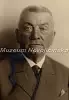
* May 12, 1856 (Pulkava) – November 26, 1932 (Baden)
Josef Rotter Sr. was a businessman, factory owner, founder of a lighting factory, and local politician from Nový Jičín. On April 23, 1877, he was drafted into the Imperial-Royal Infantry Regiment No. 4 Hoch- und Deutschmeister, where he enlisted on October 1 of the same year. He was discharged on August 26, 1878.
The following year, in February, he was already the head master in Julius Šustala's workshop in Kopřivnice, where carriage lamps were manufactured. He then decided to set up his own company in Nový Jičín, which he did by submitting his own application to the Imperial and Royal District Office in Nový Jičín. His request was granted, and in September Josef Rotter rented premises at 20 Dolnobranská Street, where he established his company in the courtyard of house no. 657. On October 4, 1879, he began operations in his workshop.
His company initially focused on the production of carriage lamps, followed by lighting for motor vehicles, locomotives, and rail transport. Later, the company became a supplier of headlights for domestic and foreign manufacturers.
In 1884, he acquired land in the village of Šenov. Two years later, factory buildings were constructed there. In the spring of 1892, extensive construction of the plant continued, including administrative and residential areas. The machines were also modernized.
In 1898, Josef Rotter applied for a court title. The application was not granted due to his radical German nationalist views. A second application for the title of Imperial and Royal Court Supplier in 1903 was also rejected. It was not until the decree of the first chamberlain of His Imperial and Royal Apostolic Majesty Rudolf, Prince von und zu Liechtenstein, dated February 10, 1906, that the title of "Hoflaternenfabrikant" was finally granted to Josef Rotter, a factory owner from Šenov.
The invention of the acetylene lamp enabled Josef Rotter to expand his production program. Its light was twenty times more powerful than that of the kerosene lamps of the time. The main customer for acetylene lamps was the state, which used them for its railways. In addition, Rotter's company produced lamps for carts, carriages, and tombstones. After 1906, Josef Rotter's factory experienced another boom. In addition to its range of products for the automotive industry, the factory received numerous orders from Vienna. Even before World War I, in the fall of 1913, Rotter employed between 60 and 80 workers.