Straník
The village of Straník is a municipal district of Nový Jičín and is located south of the town. The village is situated in the valley formed by the Straník stream. To the north and west of the village there is a large forest. The Strážnice hill rises above the village in the north-western direction, the Petřkovická hůrka (608 m above sea level) in the western direction and the Zadní hill (416 m above sea level) in the south-eastern direction.
The village was founded at the beginning of the 13th century, in the place where the forest was cleared. In written sources from 1408-1412 we find the names of Lítek or Lídek of Stranik with his wife Zdeňka, who is mentioned by Jan Kravař in his will in 1433. In 1980 there were 570 inhabitants in 139 houses, in 1991 there were 481 inhabitants in 126 houses. The village joined Nové Jičín on 1 January 1979.
The inhabitants of Stráník were mainly engaged in arable farming and cattle breeding. Many of the cottagers were engaged in crafts, especially masonry and carpentry, but many left for Nové Jičín to earn money. During the occupation, the village was first annexed to Germany, but from 24 November 1938 it became part of the Protectorate, the Valašské Meziříčí district. The village was liberated on 6.5.1945. The first chairman of the national committee was František Dorčák. Between 1975 and 1997 there was a kindergarten in the village, now there is a Senior Citizens Club and a book lending library in this building.
A shelter for mothers with children was also built in Stranik, providing short-term accommodation. The municipal seal, made in 1749, depicts a deciduous tree with four rosettes on each side.
Sights
- Pillow lavas
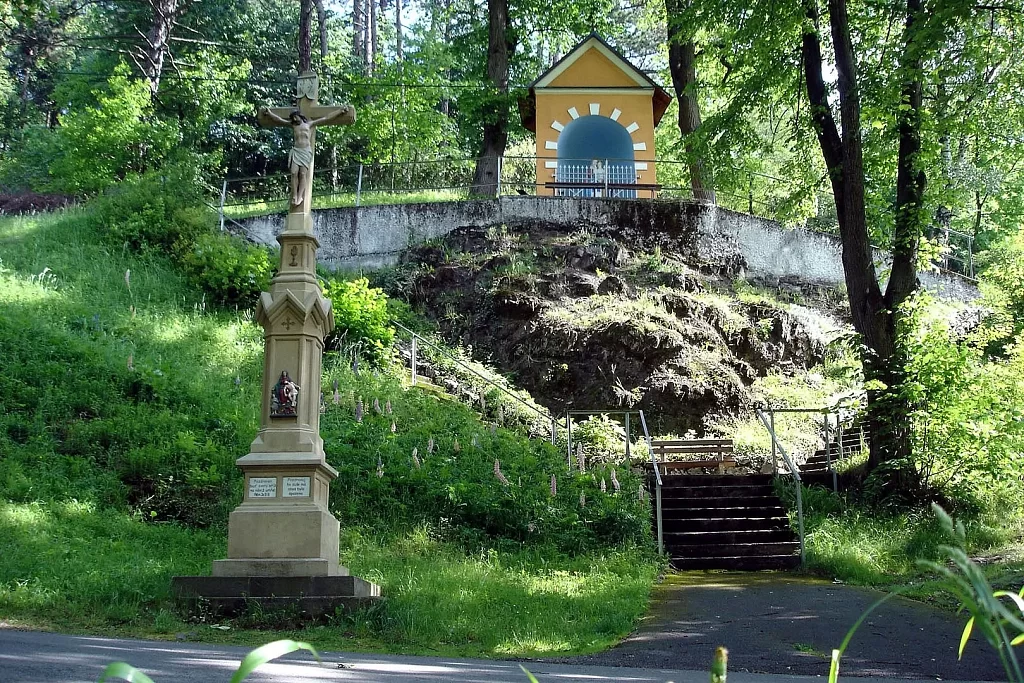
The rock below the chapel represents the last example of forms of submarine volcanic activity in the Lower Cretaceous. Pillow lavas of the Lower Cretaceous Tessinite Association of the Silesian Unit are exposed here. They consist of "loaf-like" fragments of lavas of the so-called olivine diabase to diabase picrite.
The edges of the blocks, which form the so-called limburgites, are pea-shaped. Individual blocks are cemented by younger lava with tuffitic material (volcanic sand and dust). This lava is often decomposed by secondary processes and highly carbonitised (saturated with calcium carbonate).
Pillow lavas are formed by submarine outwashing on steep slopes, when lava flowing down the slope breaks into fragments which then accumulate at the base of the slope. Skalka is a unique natural formation in the Czech Republic. According to the Nature and Landscape Protection Act, the entire formation is protected as a natural monument.
In the past, the edges of the blocks (loaves) were cut off during the construction of the double staircase to the chapel at the top of the rock.
Sports facilities
- Hiking and cycling
A red waymark runs through the village and there is a blue waymark starting point at the north-western edge of the village. In addition to hiking trails, a marked cycle path and the František Palacký nature trail pass through Stranik. The red trail leads from Nový Jičín over the Svinec peak (546 m above sea level) and continues through the village to Hodslavice. You can follow the blue trail to the recreational area near the small water reservoir Čertův Mlýn.