- Úvod - TIC Nový Jičín
- Visitor Center
- General Laudon Exhibition
- The Seven Years' War
The Seven Years' War

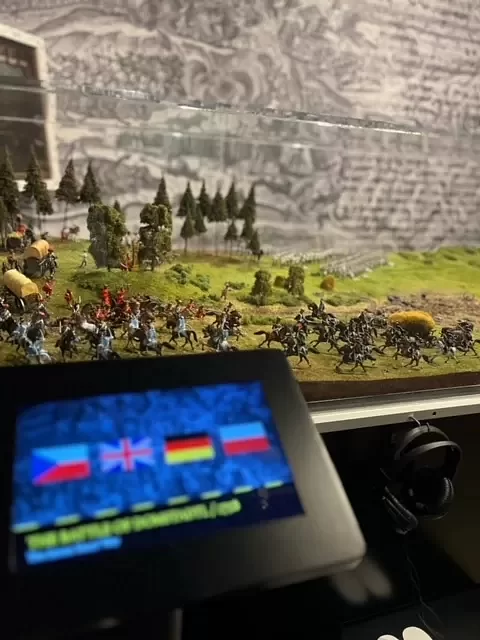
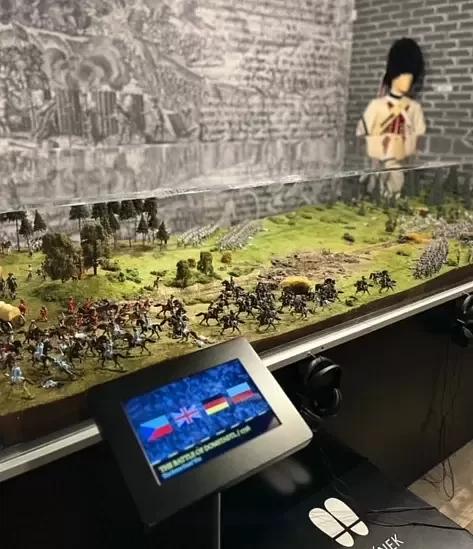
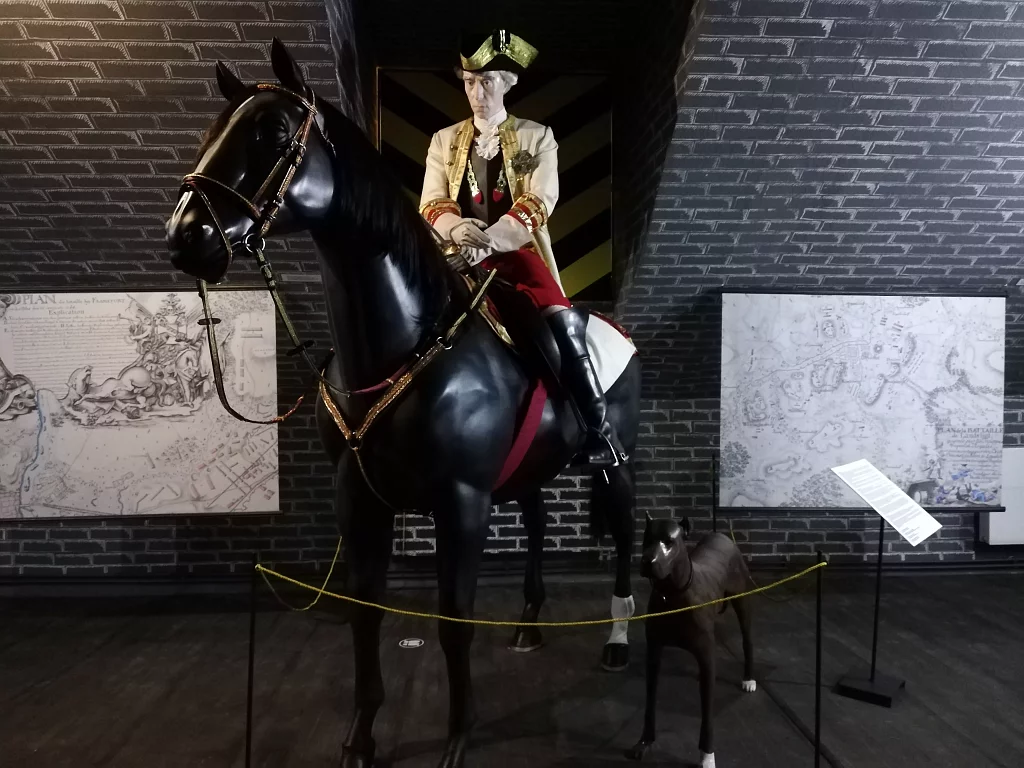
This room will introduce you to the commander through his achievements in the fight against the Prussians. It offers a three-metre high sound diorama with five hundred tin soldiers, which depicts the battle of the Moravian village of Domashov in 1758, as well as the largest 3D printed sculpture in the Czech Republic, which is registered in the Czech Book of Records. You can also watch the animated film "Laudon's Life".
Basic information about the largest 3D printed sculpture in the Czech Republic
Horse
Dimensions: height 222 cm, width 71.4 cm, length 232.3 cm. The printing of the horse itself took approximately 59 days continuously, the estimated weight is 300 kg.
Dog
Dimensions: height 90 cm, width 29,6 cm, length 110,8 cm. Approximate continuous printing time was 16 days, estimated weight is 20 kg.
Title "General Laudon"
The head is scanned from the original bust, approximate continuous printing time was 54 hours, estimated weight is 0.5 kg.
Cord
Scanned from a replica, approximate continuous printing time was 10 hours, estimated weight is 0.15 kg.
Military Order of Maria Theresa (Star of the Grand Cross of the Order with brilliants)
Drawn from photographs, approximate printing time was 2 hours, estimated weight is 0.15 kg.
From history
At the outbreak of the Seven Years' War, Laudon enlisted at the front and, through the intercession of friends, was sent to Bohemia at the head of a small frontier corps. His men brought unease to the ranks of the Prussian army, pursuing fleeing enemy troops, and conducting sudden and surprising ambushes. For his services Laudon was promoted to colonel in March 1757 and to general in August. The brave general was given command of an independent corps and on 30 June 1758 Laudon managed to disperse a supply convoy at Domashov, heading towards the Prussian army besieging Olomouc. After this action the Prussian king had to end the siege. In July, Laudon was promoted to field marshal, and after another significant success on 14 October 1758 at the Battle of Hochkirchen, he received the Grand Cross of the Order of Maria Theresa in November.
On his visit to Vienna in March 1759, he received from the grateful sovereign the estate of Malé Bečváry in Bohemia and was promoted to the status of free lord. On 12 August 1759, he reversed the almost lost battle between the Prussian king and the Russian troops at Kunersdorf with a vigorous attack. For this victory he was promoted to field armourer in November. He suffered his only defeat on 15 August 1760 at Lehnice. In 1766 he was appointed inspector-general of infantry, the following year commanding general in Moravia. In 1777 Laudon purchased the Hadersdorf estate near Vienna, and in February 1778 he was promoted to the rank of field marshal.
The story of Laudon's horse and faithful dog
War Horses and Laudon
As a field marshal, Laudon had a number of horses at his disposal, the Old Cladrucian breed or English breeds were very popular in the 18th century. Horses of dark colour, brown and black were used. The horse was specially prepared for the needs of the army, it had to withstand the loudest sounds of artillery and the turmoil of war.
The horse is also connected to a story that Laudon experienced during one of the last battles with the Turks. It is said that the horse hit him in the thigh with such force that he could not walk and had to be carried away. The wound, described as fatal, shocked all the regiments. But it was later discovered that it was not so serious.
Laudon's dog
The Mauersbach stream flows through the Hadersdorf estate near Vienna. On its banks stood a hermitage, Laudon's favourite resting place. On the afternoon of 27 July 1785, the old marshal took a short nap in the company of his little dog. When a storm broke in the mountains with a heavy downpour and the stream became dangerously swollen, the dog woke his master by barking and scratching his paw. No sooner had Laudon reached his castle than the torrent of water swept away the hermitage and devastated the surrounding garden. .
On the night of 6 to 7 January 1790, a fire is said to have broken out at Hadersdorf Castle because a hot coal fell out of the stove in Laudon's study and set fire to a basket of papers. The field marshal was asleep in the adjoining bedroom and would almost have suffocated from the smoke if he had not been woken up in time by the dog that had already saved his life once. The dazed Laudon dragged himself across the floor to the door and called the servants, who soon put out the fire.