- Úvod - TIC Nový Jičín
- Visitor Center
- General Laudon Exhibition
- Field Marshal Laudon Library
Field Marshal Laudon Library
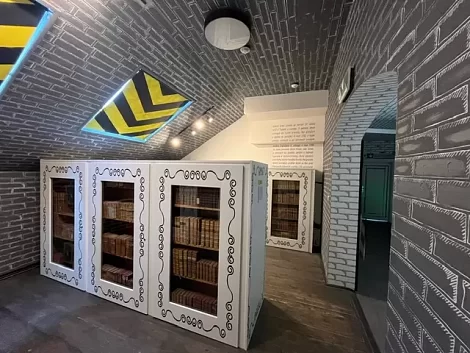
Part of the library of this famous military leader was placed in the exhibition of General Laudon in the Nový Jičín Visitor Center. These are approximately a little over a thousand volumes. Some of them were marked by the general with his supralibros, i.e. with an embossed and gilded coat of arms on the binding, and in some we can even find his personal signature.
The books date from the 17th and mainly the 18th century, the time of his life. They are bound in leather or half-leather bindings, often on spines decorated with gilded ornaments. We most often come across books in German and French, followed by Italian and English. It is not surprising that their content is often militaria, i.e. books about the military, military operations, construction of fortresses, etc. Another numerous topic is contemporary politics, history, law, sometimes also travelogues.
From history
General Gideon Ernest owned Bečváry Castle in the years 1763-1776 and collected a professional library there, which he was helped to create by the German poet Christian Fürchtegott Gellert (1715-1769), whom the general met in Karlovy Vary. The famous poet remarked "I had to set up a library for him because he lamented that he could not study in his youth." The library contained fiction, philosophy and law in addition to militaria. After the sale of the castle, the library was probably moved to the Austrian castle of Hadersdorf and later became the basis of the Loudon library at the castle in Bystřice pod Hostýnem.
Bystřici pod Hostýnem castle was purchased in 1650 by Jan z Rottal. In the years 1650-1673 his library [ELVERT] was here, but its further fate is unknown. Bystřice under Hostýn was inherited by Johann Nepomuk (1765-1827), the son of Jenofefa (1741-1810) married to (August) Emanuel count Wengerski (1727-1768), who decorated the castle, established a park here and devoted himself to music. In 1805 he adopted the predicate "Montelabate". He was a member of the Moravian Land Assembly and died childless. He built a library in the Bystřice castle, the contents of which are informed by the catalog from the beginning of the 19th century "Catalogue de la Bibliotheque du Monsieur le Comte Jean Wengersky – Montelabate Seigneur de Bistritz" [Nedělníková, MZA Brno, Fond G 194 Family archive of the Laudons Bystřice pod Hostýnem, inv. no. 1179,].
It is a local catalog (the sequence is by cabinets, rows and shelf order) with an author index, the descriptions include the title, author, place and year of publication, and the format of the book. This catalog contains almost 700 titles, of which over 100 titles are in Italian, mostly fiction, poetry and plays, over 360 French titles - novels, printed correspondence, history, philosophy and natural sciences, and over 220 titles are German. These include history, hunting, encyclopedias, ancient authors, travelogues, natural history and gardening. At the end of the inventory is a list of about 30 maps and plans. The vast majority of books were printed in the 18th or early 19th century, rarely in the 17th century, one title dates from the 16th century [it is still Anfang - citation from Soupis ...].A number of books (about a quarter) became part of the Loudon library, but it was probably a targeted selection. A few entries are noted in pencil as "Loudon", a few others are noted as "Vetter". Where the remaining books went is not clear. It is possible that this collection was damaged in the castle fire in 1833. Count Wengerský did not mark the books in any way, only one book with his signature has survived in the current Bystrica library.
During the lifetime of Johann Nepomuk Count Wengerski, a collection of plays was also collected at the castle, which was written in 1815 - "Kathalog Deren Theater Büchern von Bystržitzer Schloss Theater. Verfast am 9ten Juny 1815." This collection contained over 900 titles of librettos of stage plays and operas from the turn of the 18th and 19th centuries, mostly in German. The descriptions are very brief, they contain the number (signature), the title of the work, the format and only places the author. The theater was already performed at the Bystrica castle during the time of the Counts of Rottal, but Johann Nepomuk Wengerský set up a theater hall here and founded a volunteer ensemble and a band. The theater was equipped with eleven sets and costumes. Even though the theatrical activity at the castle continued under the free lords of Loudon, this book collection definitely did not become part of the Bystrica library that has survived to this day. Although it is striking that theatrical plays from this catalog appear to a large extent in the collection of Radenín Castle, which was collected by Filip František Count of Kolowrat-Krakowský (1756-1836), it was not possible to find evidence that it was the same collection.
Since Johann Nepomuk Wengersky of Montelabate died childless, the Bystřice castle was inherited by his half-sister, the daughter of his mother Jenofefa (1741-1810) secondly married to Johann Ferdinand Count of Fünfkirchen (1741-1789), Amalie (1776-1849) who married Johann Ludwig Alexander in 1791 free lord of Loudon (1767-1822) and Bystrica was inherited by their son Olivier of Loudon (1795-1881), great-nephew of the famous general Gideon Ernest of Loudon (1716-1790).
The general marked his books with gilded heraldic supralibros on leather baroque bindings, or signatures. Thus, approx. 500 titles are proven to come from his library, but it can be assumed that most of them are from the 18th century, which are today in the Bystrica library. Not surprisingly, the most common subject is the military, e.g. L. A. de La Mamie de Clairac: Abhandlung von der Befestigung im Felde.. Breslau und Leipzig, 1775, G. R. Fäsch: Regeln und Grundsatze der Kriegskunst... Leipzig, 1771, or F. J. ;. de Chastenet Puységur: Grundsatze und Regeln der Kriegs-Kunst... Leipzig 1753. Another favorite field of the general was history, in his library we can find the histories of Prussia, Sweden, Denmark, Russia and Bohemia, as well as biographies of Alexander the Great, Friedrich the Great, and Maria Theresa, and the book H. Lettus: Lieflaendische Chronik is a memory of the general's original homeland. Magdeburg 1747. Of interest is the German translation of the Koran from 1746. The third theme is travel writing and books about foreign countries, e.g. J. G. Gmelin: Reise durch Sibirien... Goettingen, 1751-1752. A smaller amount of the book is devoted to gardening, and we can also find the aforementioned supralibros on dictionaries and encyclopedic books. The general's library also included a large collection of maps and plans.
The map collection contains a total of over 1000 maps and plans, both civil and military. Civilian maps are mostly from the 17th and 18th centuries, they are prospectuses of European cities, maps of European states, and many geographical atlases, e.g. a manuscript map of the Danube from 1779, a manuscript map of the Morava River from 1719, or a manuscript map of the military cordon on the Silesian and Kladsk borders from 1763. From the printed maps, you can draw attention to the map Hungary by Martius Stier from 1664, G. M. Vischer from 1697 and Upper Austria from 1667. Very valuable is Vischer's map of Moravia from 1692 and there are also well-known maps of Bohemia by Johann Christoph Müller from 1720 and 1726. The military maps, all of them, represent the siege of Belgrade 1789, encampment of troops in various places, e.g. in Banjaluka, situational and operational plans of Austrian, Prussian and Russian troops, drawings of positions of the Turkish army, plans of fortresses in the Balkans and in Central Europe.
The library was further expanded by the descendants of the general's nephew, Olivier (1795-1881), to whom numerous botanical works can be attributed, his son Ernst Olivier (1832-1915). Perhaps during his lifetime, part of the library was marked with a heraldic ex-libris with the text "EX LIBRIS LIBERI BARONIS A LOUDON BIBLIOTHECA BISTRICENSIS (HOSTEIN)".
The last extenders of the library were his son Ernst Gideon (1886-1944), his wife Wilhelmine Countess of Thun and Hohenstein (1892-1957) and their children.
In the 1930s, the Loudons were forced to sell the castle Bystřice pod Hostýnem and moved to a rented villa in Ždánice, perhaps with a library. In the early 1950s, the library was first located in the castle in Valtice, then it was transferred to the castle in Vranov nad Dyjí. In 1962, the library was taken to Bítov Castle, and from there in 2002 to the Novojičín Museum, when it was reinstalled in 2006. Now part of the library is located in the Nový Jičín Visitor Center.